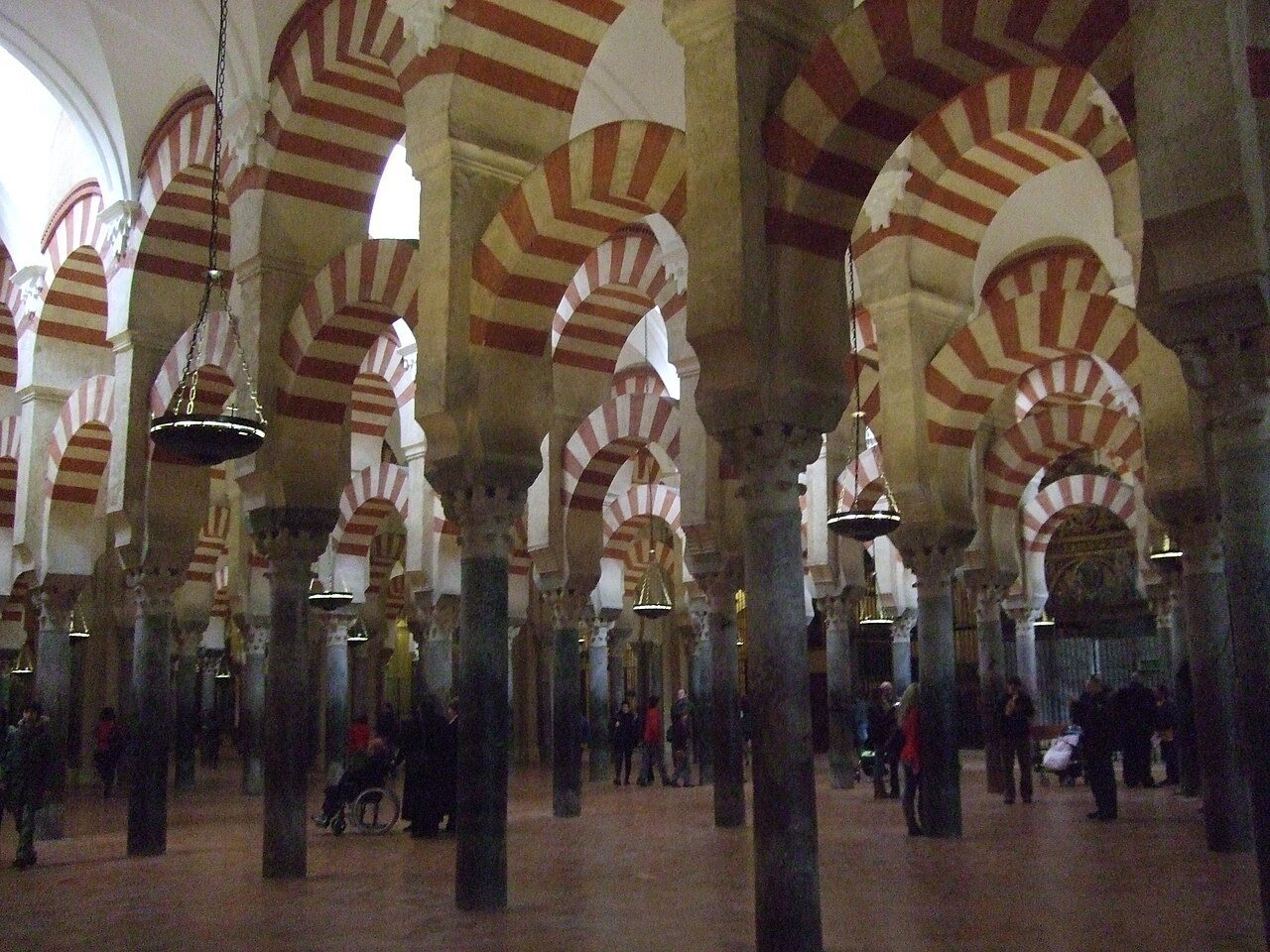
Walk into the prayer hall of the Mezquita-Catedral and the first thing that registers is the repetition: hundreds of columns, red-and-white striped arches receding in every direction. The second thing, if you slow down, is that the columns don't match. Some are taller than others. Some capitals are carved in one style, some in another, and a few look like they've been turned upside down or wedged in sideways to make the height work. That mismatch isn't a flaw. It's the point, and it has a name: spolia.
What "spolia" actually means
Spolia is the term historians and archaeologists use for building material taken from an older structure and reused in a new one — not melted down or reworked from scratch, but lifted more or less intact: a column shaft, a capital, a marble slab, sometimes an entire door frame. It's a Latin word (the plural of spolium, "spoil" or "plunder"), and it was standard practice across the ancient and medieval Mediterranean. Builders didn't see it as compromise. A column quarried and carved by earlier hands, especially from a building associated with imperial power, carried its own prestige. Reusing it wasn't cutting corners — it was borrowing authority.
The Mezquita is one of the best places anywhere to see this practice at scale, because the mosque begun in the late 8th century under Abd al-Rahman I was built directly on the site of earlier structures, in a city that had already been Roman and then Visigothic for centuries. The builders didn't need to import much of their raw material. It was already lying around, or still standing, a short cart ride away.
Where the columns came from
Córdoba had been an important Roman provincial capital, and the visible remains of that city — including the standing columns now displayed near the Diputación, covered in the Roman Córdoba section — are only a fragment of what existed by the 8th century. Temples, basilicas, and public buildings across the city and region had been abandoned, collapsed, or partly dismantled over the preceding centuries, and their marble was sitting there for the taking. Visigothic Córdoba added another layer: churches built in the 6th and 7th centuries, some possibly on the very ground where the mosque now stands, contributed their own capitals, carved in the distinctive basket-weave and leaf patterns that Visigothic masons favored, quite different from Roman Corinthian work.
Later chroniclers also describe columns and materials arriving from further afield — from old Roman sites elsewhere in the Iberian peninsula, and, according to some medieval accounts, even from further around the Mediterranean as diplomatic gifts during later phases of construction. These accounts aren't uniformly reliable and the details are debated among historians, so it's fairer to say the column stock is a patchwork of local recycling and, probably, some longer-distance additions, rather than to pin an exact tally or origin to any given column.
What's not in dispute is the practical outcome: the mosque's builders were assembling a forest of support from whatever sound marble and granite shafts they could gather, not quarrying a uniform set to order. That's visible the moment you know to look for it.
How to actually spot it
The columns in the prayer hall were never going to be identical, because they weren't cut for this building. The masons solved the mismatch with a fairly blunt but effective trick: they built up the bases, adding plinths of different heights under shorter columns so that the tops would line up and the two-tier arch system above could sit level. If you look down rather than up, you'll notice the bases aren't uniform — some columns seem to be standing on a visible extra block of stone, almost like a shim.
- Capital styles that don't match their neighbors: Corinthian capitals with acanthus leaves sit near capitals with a more geometric, woven look. The second kind are usually Visigothic, the first usually Roman — though converted mosque-and-church centuries later did quite a bit of recarving and infill work too, so treat this as a general rule, not a guarantee for any single column.
- Stone color and grain: the shafts vary from gray granite to different marbles, some with visible pink or blue-gray veining. A uniform quarry order would never look like this.
- Slight diameter mismatches where a shaft meets its capital — a capital carved for a slightly wider or narrower column than the one it now sits on.
- Fluting that stops abruptly or doesn't wrap the whole shaft, a sign the column was cut down from something taller and re-finished at the top or bottom.
⭐ The easiest place to start looking is near the Patio de los Naranjos end of the hall, where the light from the courtyard doors is strongest and the base-and-capital mismatches are easier to see without a flashlight or squinting into the dim central bays.
⚠️ Don't expect labels. The Mezquita-Catedral doesn't tag individual columns by origin, and for a great many of them the origin simply isn't documented — so what you're doing is pattern-spotting, not reading a catalog. Treat any specific claim you hear from a passing guide about "this column came from Carthage" or similar with a little skepticism unless they can point to a source.
Why it matters beyond decoration
The spolia columns are a physical record of layered conquest and reuse that the rest of the city tells in fragments — the Roman street grid still under parts of the old town, the Visigothic and Roman spoils built into later Islamic and Christian structures, right through to the Alcázar de los Reyes Cristianos, where Roman mosaics were later relocated and displayed after being found elsewhere in the city. Córdoba's builders across three religions and many centuries kept doing the same thing: rather than start from bare ground, they took what was standing and folded it into what came next. The Mezquita's columns are simply the largest and most visited example of that habit, hiding in plain sight under some of the most photographed arches in Spain. For more on how the mosque was expanded across those centuries, see the Mezquita section overview, and for the wider historical backdrop, Al-Andalus.
In pictures