Walk the old Jewish quarter and you will meet two bronze men within about ten minutes of each other. One sits, robed and thoughtful, in a small square called Tiberíades. The other stands near the Puerta de Almodóvar, where the medieval walls still run, gesturing as if mid-argument. They are Maimonides and Averroes, and the city has built a large part of its identity around them: two of the most important thinkers of the Middle Ages, both born in Córdoba within about twelve years of each other, in the twelfth century. The usual story told to visitors is that this proves something about Córdoba — that it was a place so tolerant, so intellectually open, that a Muslim philosopher and a Jewish philosopher could both flourish there. The plaques nearby lean into this. The truth underneath it is more complicated, and more interesting, than the plaques let on.
Who they actually were
Ibn Rushd — Averroes to the Latin West — was born in Córdoba around 1126 into a family of judges. He became a judge himself, in Córdoba and in Seville, and later a physician at the Almohad court in Marrakesh. His real importance to intellectual history is as a commentator on Aristotle: his close, systematic readings of Aristotle's texts were translated into Latin and Hebrew and shaped university philosophy in Paris and Padua for centuries. Dante put him in Limbo among the virtuous pagans, a mark of serious respect. In the Islamic world, his attempt to reconcile philosophy and religious law made him a target for suspicion as often as for admiration.
Moses ben Maimon — Maimonides, or Rambam — was born in Córdoba around 1138, into a family of rabbinic scholars. Unlike Averroes, he did not get to build a career in the city of his birth. By the time he was a child or a young teenager, his family had left. He eventually settled, after years of moving, in Fustat, near Cairo, where he became physician to Saladin's court and wrote the works that made him the most influential Jewish philosopher of the medieval period: the legal code known as the Mishneh Torah and the philosophical treatise known in English as the Guide for the Perplexed, both composed far from Córdoba, in Egypt.
That detail — that Maimonides wrote almost nothing in the city that claims him — is the first crack in the tidy version of the story.
Why they both left
The reason Maimonides' family left, and the reason Averroes himself was later exiled for a period from the Almohad court, is the same reason: the Almohads, a Berber Muslim dynasty that took control of al-Andalus in the mid-twelfth century, imposed a harder religious line than the rulers before them. Jewish and Christian communities faced new restrictions and, in some accounts, forced conversions. Maimonides' family is generally thought to have left Córdoba in response to this pressure, moving through southern Spain and North Africa before reaching Egypt. Averroes, decades later, fell out of favor with the Almohad caliph over his philosophical writing and was banished for a time to a town near Córdoba before being reinstated shortly before his death in Marrakesh in 1198.
In other words: the two men the city holds up as the proof of its tolerant, multicultural past are, more precisely, evidence of the opposite moment — a hardening of religious policy that pushed a philosopher out of favor and pushed a Jewish family out of the city entirely. Their fame was built elsewhere, in Cairo and in the universities of Latin Europe, not in Córdoba.
⚠️ None of this means the Córdoba of the Caliphate, a couple of centuries earlier, wasn't genuinely a place where Muslim, Jewish, and Christian communities lived and worked in proximity, with real intellectual exchange — translation, medicine, astronomy. It means the specific symbol the city reaches for, two men from the Almohad era, doesn't quite match the specific claim being made about coexistence. The golden age the statues gesture toward and the century the two men actually lived in are not the same century.
What the statues are actually doing
The Maimonides statue in the Judería, in Plaza Tiberíades, is one of the most photographed things in the quarter, partly because visitors have taken to touching or rubbing his shoe, a habit that has no documented medieval precedent but has become a genuine modern local custom. The Averroes statue stands outside the walls near the old gates, at the edge of where the city's historic core gives way to the Puerta de Almodóvar roundabout — worth the short walk if you're already heading toward the Calleja de las Flores or the synagogue. Neither statue is medieval; both are twentieth-century additions, part of a deliberate civic project to recover and display a "three cultures" narrative that Córdoba has marketed hard since the mid-twentieth century, well before UNESCO listed the historic center.
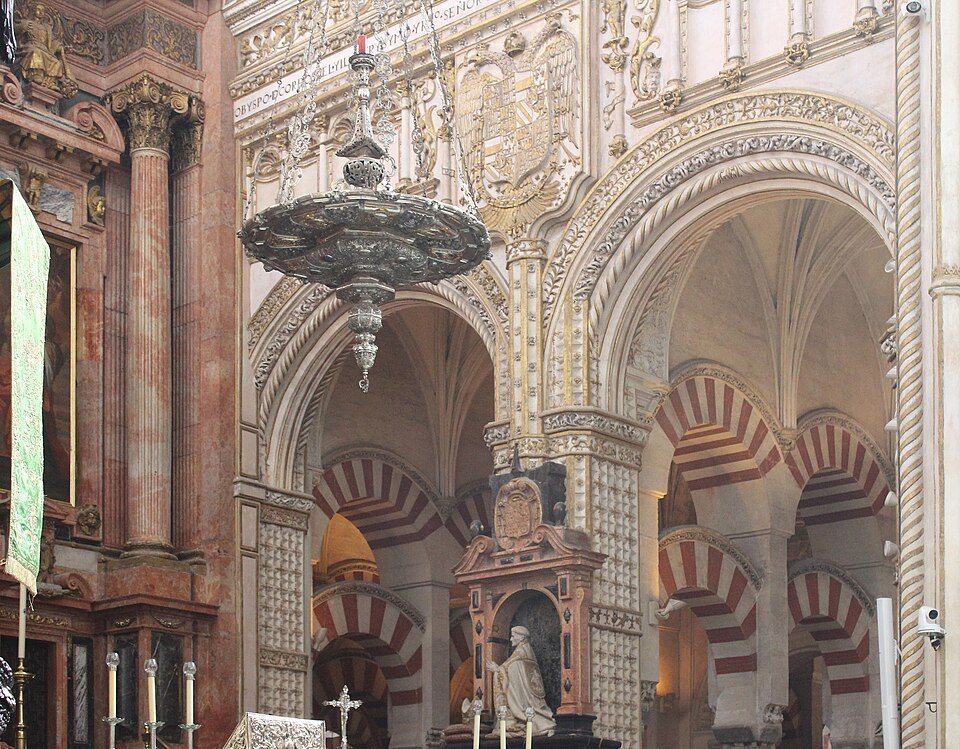
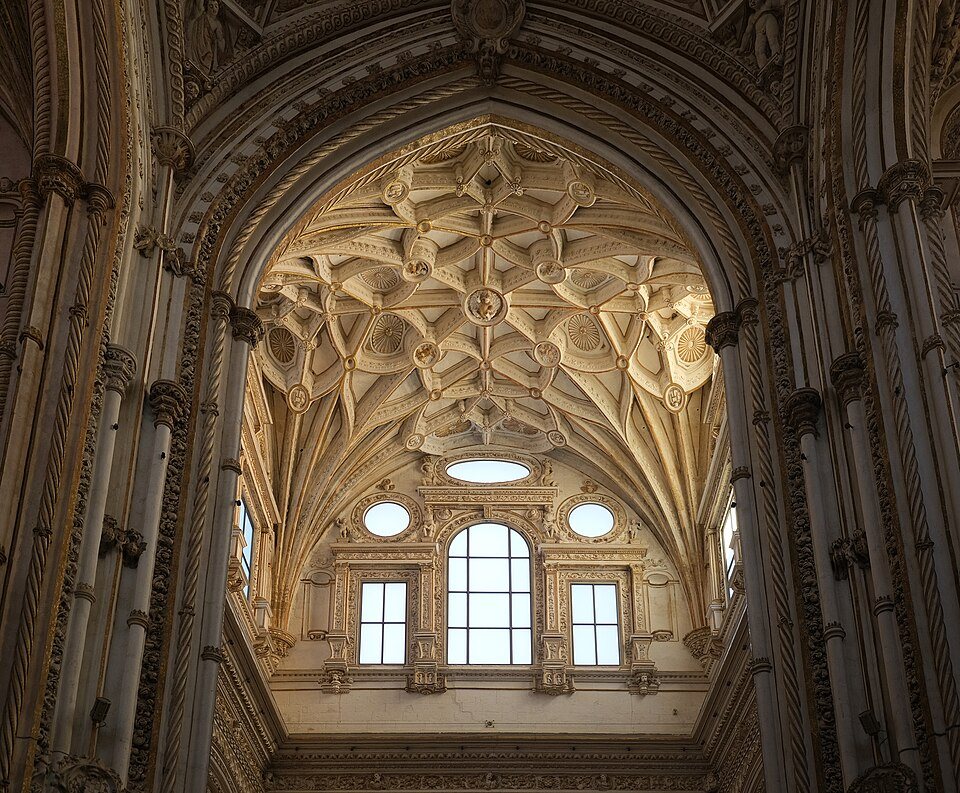
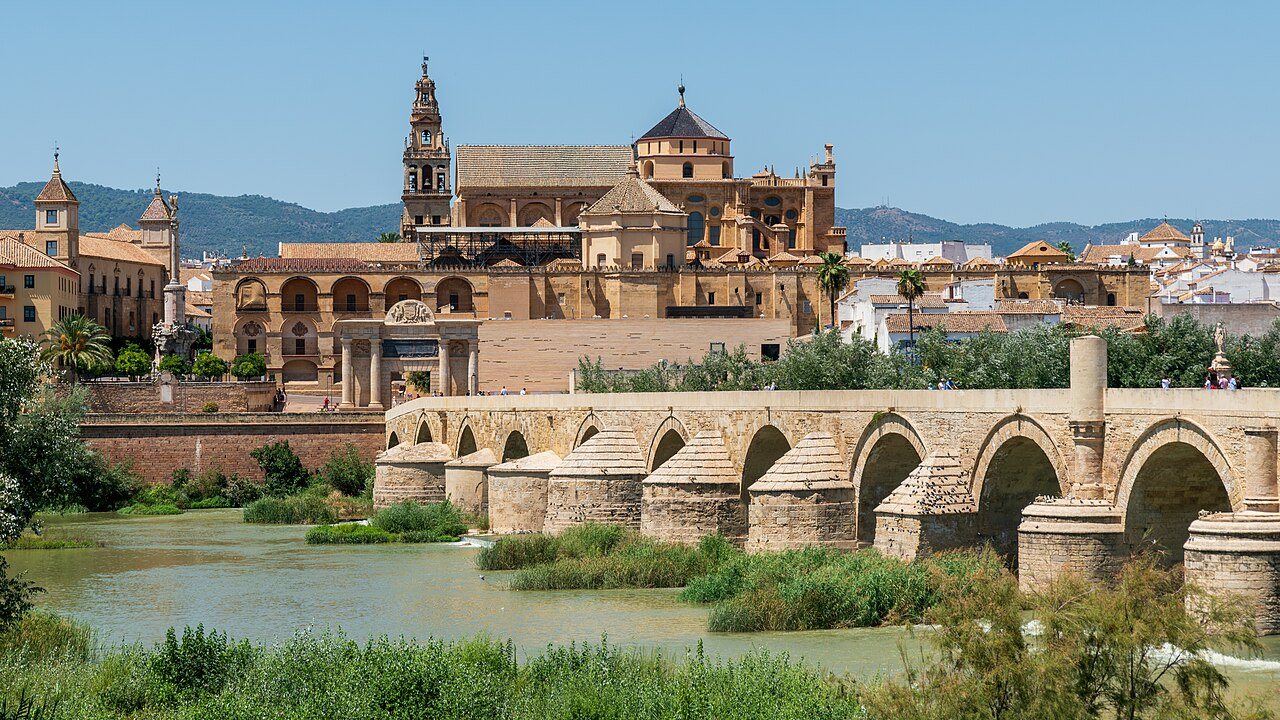
⭐ If you want the more honest version of the story rather than the plaque version, read the inscriptions at both statues critically: they tend to list achievements and dates without mentioning exile, banishment, or the Almohads by name. Pair the visit with the Mezquita-Cathedral itself, whose own layered history — Visigothic church, great mosque, Christian cathedral grafted into its center — makes the same point architecturally that the statues make biographically: Córdoba's history is not one continuous harmony but a sequence of different regimes, each rewriting what came before, sometimes violently.
What the city should claim instead
The more defensible version of Córdoba's claim isn't "this was always a place of tolerance." It's narrower and arguably more impressive: this was a place dense enough, educated enough, and interconnected enough across centuries of different rulers — Roman, Visigothic, Umayyad, Almohad, Christian — that it kept producing thinkers of world importance, even when those thinkers eventually had to leave or fell out of favor at home. Seneca and Lucan, centuries earlier, are the Roman-era version of the same pattern, discussed in more detail under Roman Córdoba. Córdoba's actual claim to fame is less "a place where everyone got along" and more "a place that kept being a center of gravity for serious thought, under wildly different and often intolerant regimes." That's a smaller, truer claim than the brochure version, and it survives scrutiny better.
If you're building a day around this theme, the itineraries section groups the Judería sites in a walkable sequence; the al-Andalus section covers the wider historical arc these two men sit inside. Go see both statues — they're close together, free to visit, and worth five minutes each — but read the fine print with a little skepticism, the way you'd read any civic monument anywhere.
In pictures