The Mezquita was not built once. It was built four times, by four different rulers, over roughly two hundred years, and each addition was bolted onto the south end of the one before it. That's the trick to understanding the building without a guide: walk from the entrance at the Patio de los Naranjos toward the far wall, and you are walking forward in time. The columns change. The arches change. The stone changes. You just have to know what to look for.
Why the building grew southward at all
Córdoba's Great Mosque began under Abd al-Rahman I in the late 8th century, on a site that had already held a Visigothic church and, before that, Roman foundations — a layering the city repeats everywhere, from the Roman temple to the Roman bridge. As the city and its Muslim population grew under the Umayyad emirs and then caliphs of al-Andalus, the mosque had to grow with it. There was no room to expand east — the river sat close by — so successive rulers simply extended the prayer hall further south, campaign after campaign, absorbing the old qibla wall into the middle of the new building each time.
That's worth pausing on, because it explains the single strangest feature for first-time visitors: this qibla wall, the one indicating the direction of prayer, faces roughly south rather than southeast toward Mecca. Historians still debate why — a nod to the qibla orientation used in Umayyad Damascus, a simple continuation of the original Roman street grid, or something else — but no one has settled it definitively, so it's fair to hold it as an open question rather than a fact.
Campaign one: Abd al-Rahman I, the columns doing double duty
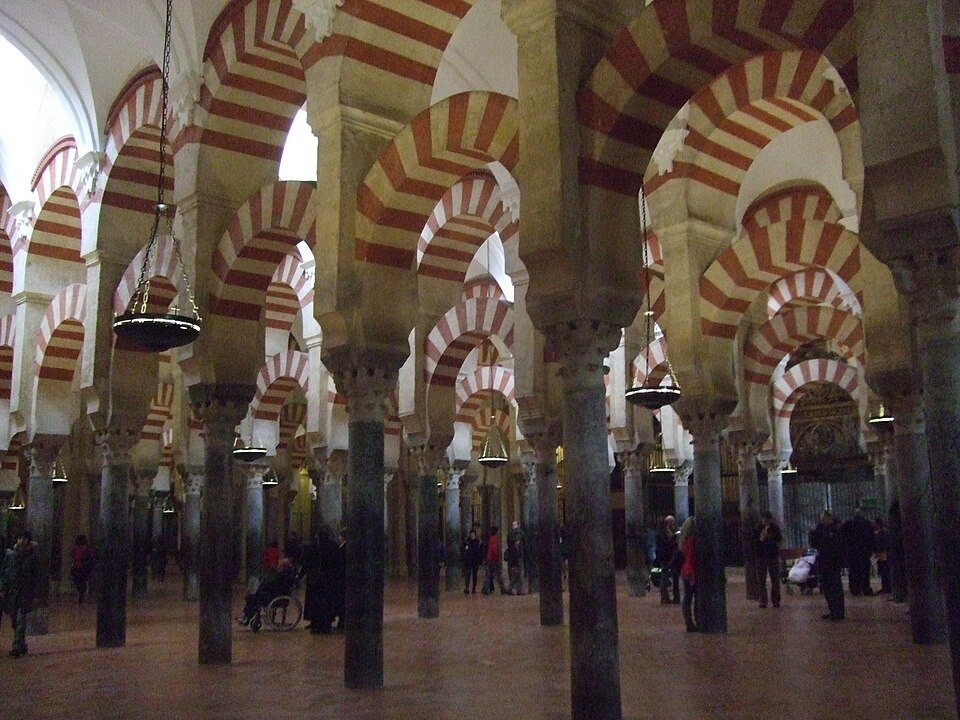
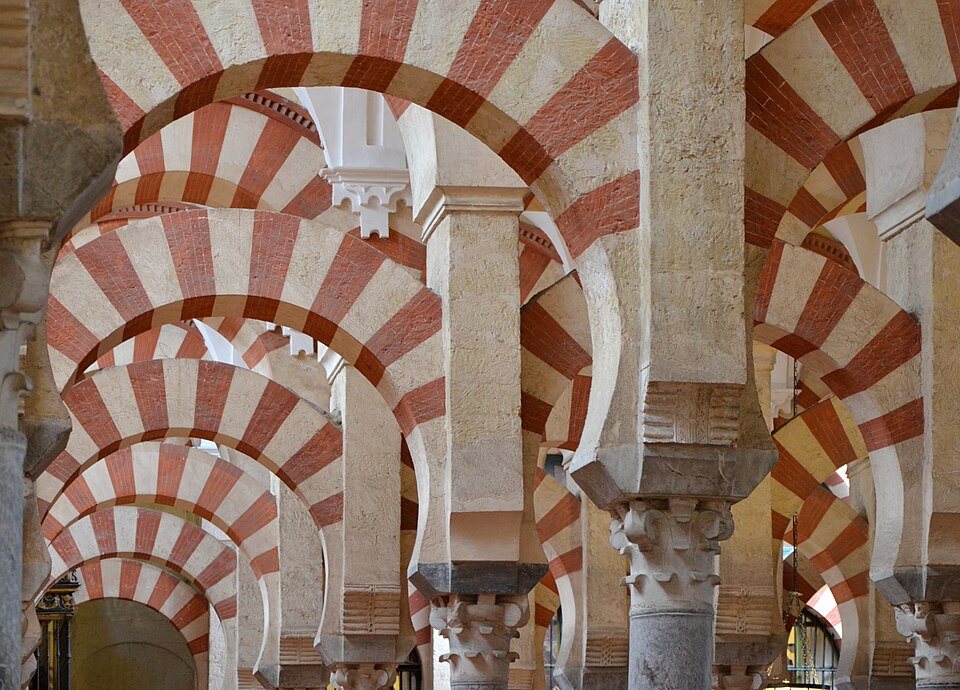
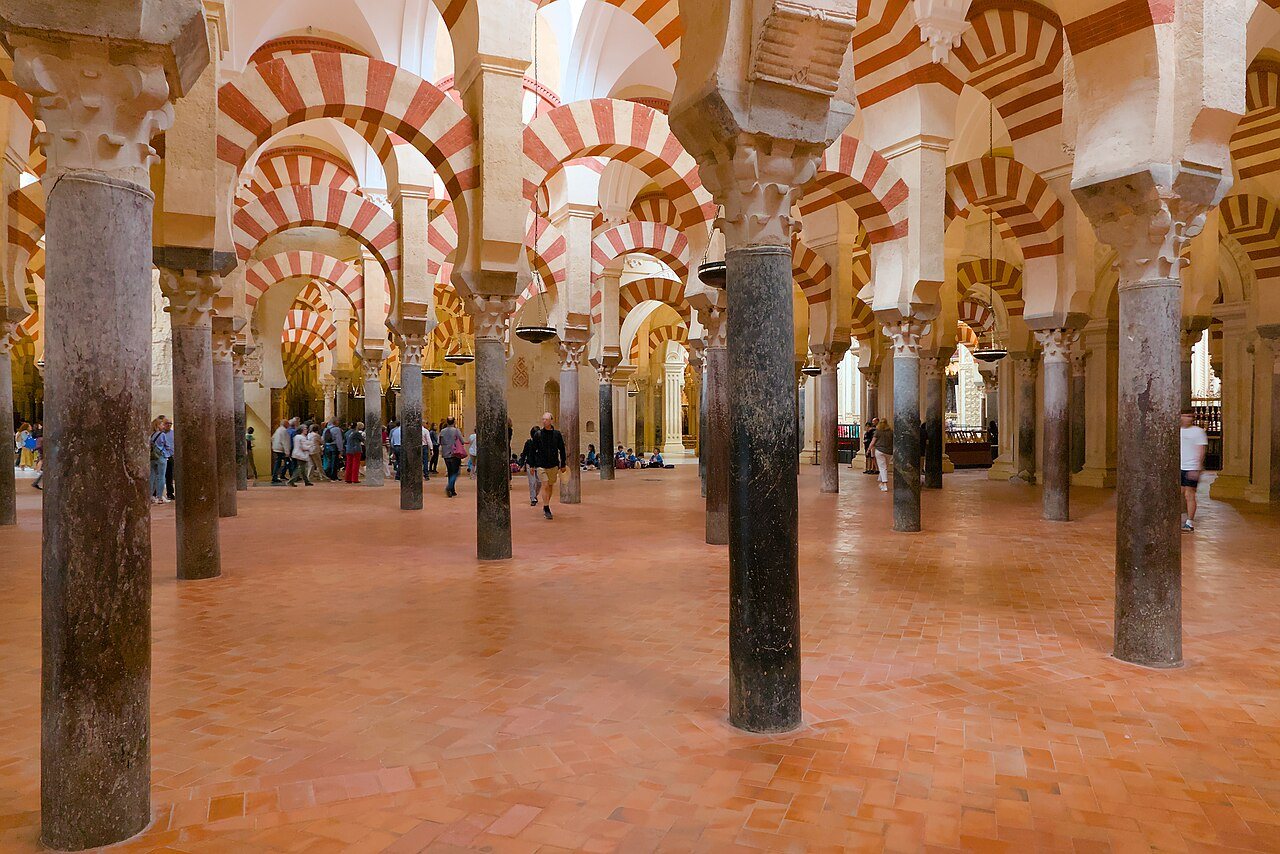
The oldest section sits closest to the Patio de los Naranjos, and it's the one built from recycled parts. Abd al-Rahman I's architects reused columns and capitals scavenged from Roman and Visigothic buildings around the city, which is why no two columns quite match — different marbles, different capital styles, some clearly older than the mosque itself. To get enough height out of shafts that were often too short, they stacked a second tier of arches on top of the first, producing the famous two-tier arcade of alternating red-and-white voussoirs. The red isn't stone throughout; in places it's brick, painted to keep the rhythm going. Stand under this section and the effect is deliberately disorienting — rows of horseshoe arches receding in every direction, no single vanishing point pulling your eye toward an altar or mihrab, which was rather the idea in a hypostyle prayer hall built for a rank-and-file congregation, not a processional view.
Campaign two: Abd al-Rahman II pushes south
By the mid-9th century the original hall was too small, and Abd al-Rahman II extended it further south using the same double-arch system, but here the columns and capitals are less obviously mismatched — quarried and carved to order rather than scavenged, a sign of a more confident, better-resourced state. The transition between his work and his predecessor's is subtle rather than dramatic; look for a slight shift in the color and finish of the capitals rather than any obvious seam. This is the section where the building starts to feel less improvised and more like an established institution repeating a formula it already trusts.
Campaign three: al-Hakam II and the mihrab that changes everything
Keep walking south and the building suddenly gets more ambitious. Al-Hakam II's 10th-century extension, undertaken at the height of the Córdoba Caliphate, is where the decoration shifts from repetition to spectacle. The arches multiply into interlacing, lobed forms; ribbed domes appear overhead, supported on crossing arches rather than simple lintels; and the maqsura — the enclosure reserved for the caliph — is framed with mosaic work that, by most accounts, involved craftsmen or materials sent from Byzantine Constantinople, a diplomatic gift as much as an artistic one. This campaign culminates in the mihrab, not a shallow niche but a small, octagonal room faced in gold-ground mosaic, its horseshoe arch cut from a single, oversized block of marble. It is the visual and, for the caliphate, political high point of the whole building, and it rewards slowing down more than any other spot in the complex. ⭐ Stand back a few paces rather than crowding the rail — the mosaic reads better as a whole panel from a short distance, and the crowd around it clears in waves rather than steadily.
Campaign four: Almanzor widens rather than lengthens
The last major campaign, under the regent Almanzor in the late 10th century, couldn't extend south any further — the river was already close, and by this point there simply wasn't a straightforward run of open land left. So instead of adding depth, Almanzor's architects added width, extending the entire hall to the east by roughly a third. It's the largest single campaign by area, but architecturally the plainest: the same horseshoe arcades, repeated competently but without the inventiveness of al-Hakam II's work next door. Walking from the al-Hakam section into the Almanzor extension, the columns get noticeably more uniform and machine-like in their regularity — a sign of mass production rather than individual carving. This is also, not coincidentally, roughly where the 13th-century Christian cathedral nave was later inserted after the Reconquista, cutting straight up through the middle of the hypostyle hall and letting daylight into a building that had always been designed for filtered, ambient light instead.
What this means for your visit
None of this requires an audio guide to see, but it does require knowing to look for it — most visitors walk straight to the mihrab and back, missing the fact that they've just crossed two centuries of construction on foot. ⚠️ The building functions as a working cathedral, and the Catholic Church's position is that it is not open for Islamic prayer; that remains a live and unresolved dispute, and staff will ask visitors not to pray inside regardless of faith. For practical matters — how to get in, what's included, how the site is organized alongside the courtyard and bell tower — the Mezquita-Catedral page and the operator's own current information are the right place to check before you go. Pair the visit with a walk out to the Puerta del Puente and across the Roman bridge to the Torre de la Calahorra, where the view back across the river puts all four campaigns in a single frame at once.
In pictures