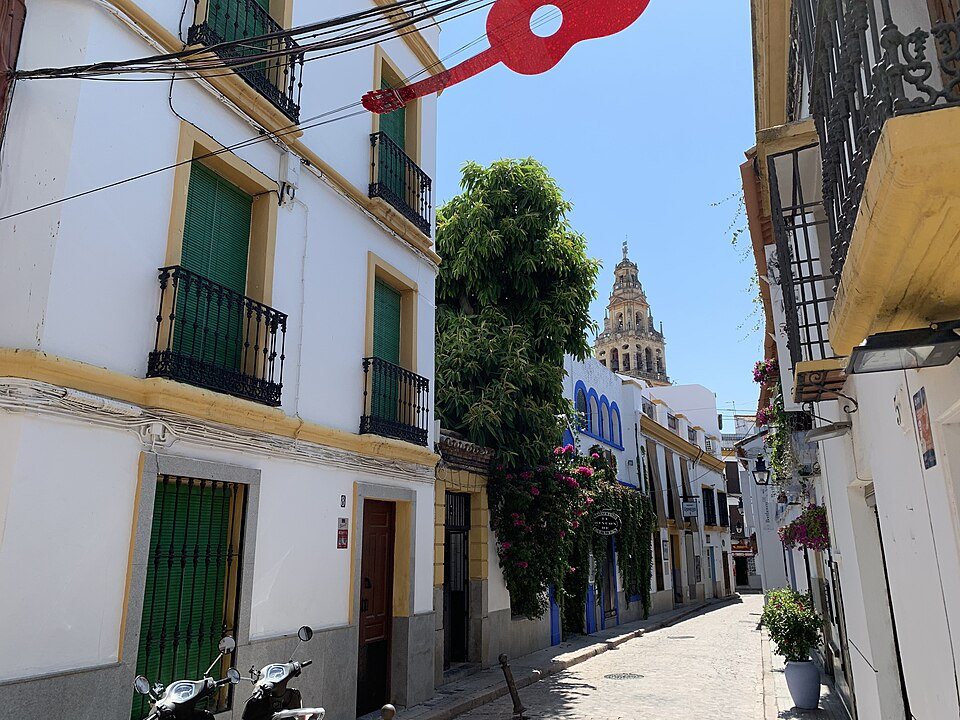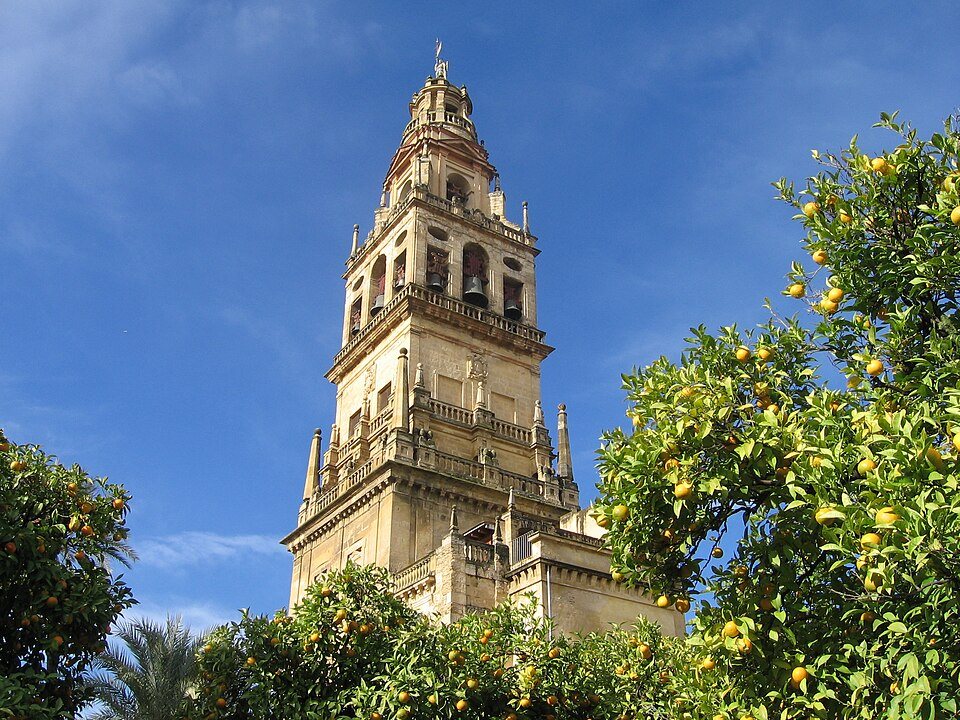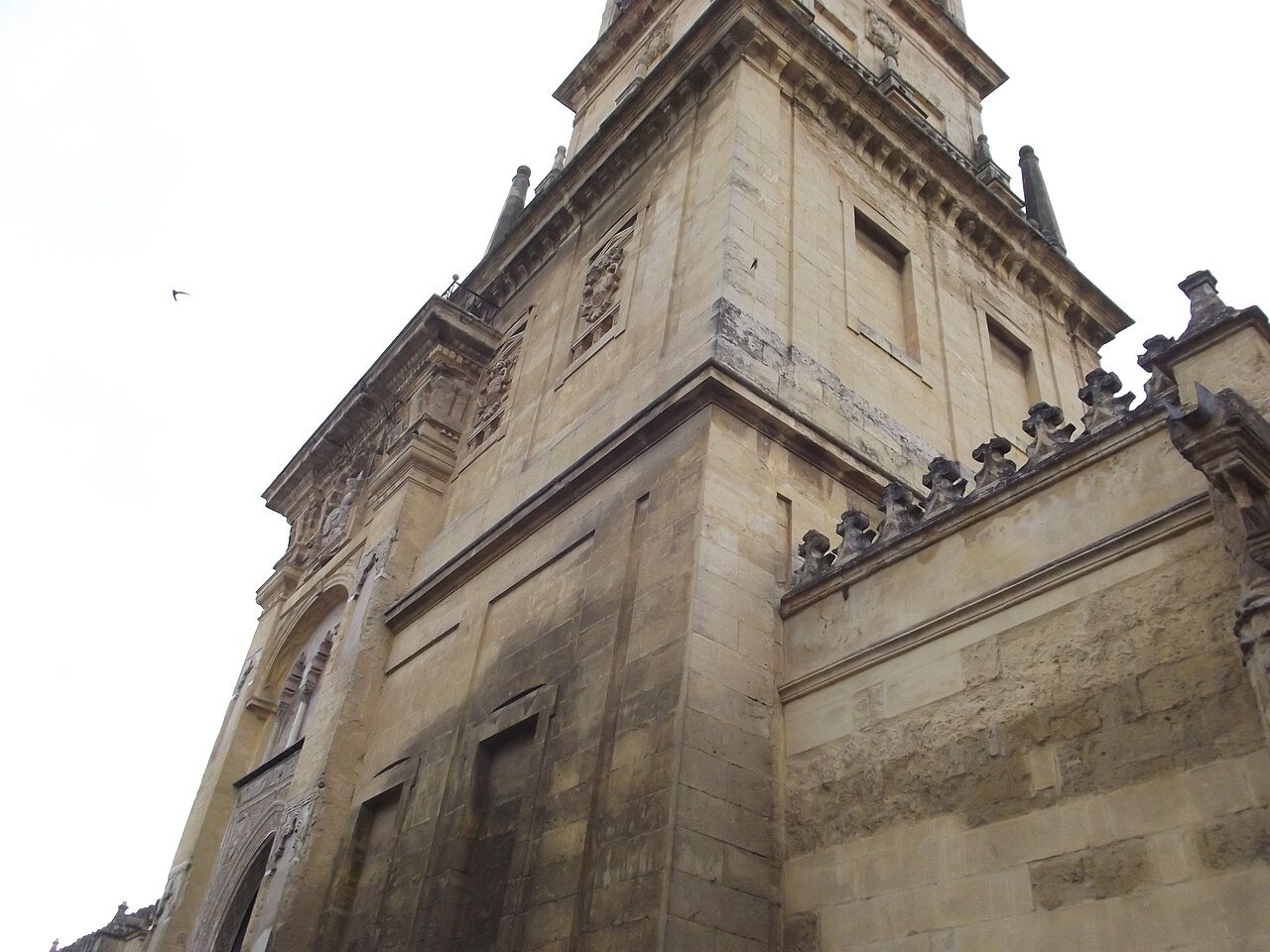
Stand in the Patio de los Naranjos and look up at the tower on the north side. It reads, at a glance, as a Spanish Baroque bell tower, because that is what its skin is: stone belfry, ornamental urns, a weathervane figure of San Rafael on top, the whole vocabulary of 17th-century Catholic Córdoba. What the skin is wrapping is older and stranger. Inside that tower, encased like a core sample, is the minaret that Abd al-Rahman III had built in the 10th century, when this was the main mosque of a caliphate and the tower's job was to call people to prayer, not to ring for Mass.
This is not a hidden secret — guides mention it, the information panels mention it — but it's easy to walk past the tower on your way into the Mezquita-Catedral without quite registering what you're looking at. You are looking at two buildings. One is standing where the other used to stand, built using it as scaffolding.
Why there's a mosque's minaret inside a cathedral's tower
The original minaret dates to the mid-10th century, part of the major expansion under Abd al-Rahman III, the first Umayyad ruler of Córdoba to claim the title of caliph. A minaret at that scale was not just functional; it was a statement about the city's standing relative to Damascus and Baghdad, the older centers of the Islamic world Córdoba was trying to rival. For centuries after the Christian conquest of the city in 1236, that minaret kept doing a version of its old job — it was adapted for bells rather than demolished, because reusing a tall, structurally sound tower is easier than building one from nothing.
The minaret was damaged over time and, by most accounts, compromised further by a storm in the late 16th century. Rather than clear the site, the chapter commissioned Hernán Ruiz III — part of a family of architects who worked on the cathedral project across generations — to wrap the old structure in a new one. The result is the tower you see today: Renaissance and Baroque on the outside, a Caliphal-era core somewhere inside the walls, invisible unless you already know to look for the seam.
The habit of building around things, not instead of them
The tower is the clearest single example of a pattern that repeats across the whole site and, really, across Córdoba. The Mezquita itself incorporates columns and capitals scavenged from Roman and Visigothic buildings — a visible mismatch of styles and stone types if you look closely at the forest of columns in the prayer hall, because they weren't quarried to match each other; they were gathered. Beneath the floor, excavated remains suggest an earlier Visigothic church, San Vicente, occupied part of the site before the mosque was built — the usual account is that the Muslim conquerors initially shared the building with Christian worshippers before the mosque absorbed the whole plot. In the 16th century, the cathedral chapter cut a full Renaissance nave straight into the center of the old hypostyle hall, against the wishes of the city council and reportedly to the dismay of Charles V himself, who is said to have told the canons they'd destroyed something unique to build something that could have gone up anywhere. Whether or not he used those exact words, the nave is there, and it does look like an intrusion into a different kind of space.
None of this was architectural preservation in the modern sense. Nobody involved was trying to protect a monument for its own sake. They were solving practical problems — a damaged tower, a growing congregation, a shortage of matching building stone — using whatever was already standing. The layering is a byproduct of economy, not an aesthetic choice, which is partly why it still reads as honest rather than curated.
Seeing it for yourself
Access to the tower is separate from the general admission to the Mezquita-Catedral and runs on its own system of timed, limited-capacity visits, usually with a cap on how many people go up at once given how narrow the stairs are inside. ⭐ Book this one in advance through the cathedral's own visitor information rather than assuming you can add it on after you've already toured the mosque — the slots fill, and there's no guarantee of a same-day spot. Check current arrangements directly with the site; this changes and isn't something to guess at.
⚠️ The climb is a tight spiral stair, not a lift, and it's genuinely narrow in places — fine for most people, awkward if you're claustrophobic or traveling with a stroller, which has to stay at the bottom.
From the top, the payoff is a view that makes the city's layout legible in a way street level doesn't: the Roman bridge and the Torre de la Calahorra on the far bank, the dense roofline of the Judería running off to one side, and the Mezquita's own roofline immediately below you, red tile over a vast flat expanse of what used to be open-air prayer space and column halls. It's one of the few spots in the city where you can see the Roman, Islamic, and Christian layers of Córdoba from a single fixed point without having to walk between them.
What to look for from the ground
If you don't go up, the tower still rewards a slow look from below, ideally from a couple of different angles — once from inside the orange-tree patio, once from the plaza outside the Puerta del Puente side. From the patio you're mostly seeing the Baroque shell and the belfry stage. From outside, with the Guadalquivir and the Roman bridge in the same sightline, the tower sits in a view that's barely changed in silhouette for a few hundred years, even though almost nothing in that silhouette is what it was when it was first built — the bridge rebuilt on Roman foundations, the tower rebuilt on a Caliphal one, the whole scene an accumulation rather than an original.
That's arguably the real subject of a visit to the Mezquita-Catedral generally, and this tower is where it's easiest to explain in one sentence: almost nothing standing in central Córdoba was built once. Nearly all of it was built again, on top of, or around, something else that was already there. The tower just happens to make that pattern visible from the outside, if you know which seam to look for.
For how this fits into a wider walk through the old city, see Al-Andalus for the historical context and Itineraries for routes that pair the Mezquita-Catedral with the river and the Judería in a single morning.
In pictures