Córdoba likes to advertise its Islamic centuries, and fairly so — the Mezquita-Catedral dominates the skyline and the tourist brochures. But scrape a few meters down almost anywhere in the old quarter and you hit a different city: Colonia Patricia Corduba, a Roman provincial capital that laid out streets, built a theater, raised temples, and bridged the Guadalquivir centuries before anyone here had heard of Islam. Much of it never left. It is just underneath — literally, in the case of a museum, a city hall, and a bridge still in daily use.
A grid that never got erased
Roman Corduba was founded in the second century BC and later served as capital of the province of Hispania Ulterior Baetica — a regional seat of government, not a backwater. The street grid the Romans laid out in the area around what is now the Judería and the streets east of the Mezquita still shapes the way those blocks are cut today; later Moorish, medieval, and modern builders mostly built within the lines rather than erasing them. That is one reason the old town feels dense and angular rather than organic — underneath the later layers is a planned Roman city, and plans are stubborn.
What you can actually see of that city, though, is scattered and often half-hidden, tucked into basements, glass floors, and the foundations of buildings put up for entirely different purposes.
The theater under the museum
The clearest case is the Museo Arqueológico. In the 1990s, construction work next to the museum's main Renaissance palace turned up the remains of a Roman theater — a large one, built into the slope near the river, which had simply been built over and forgotten for centuries. The museum absorbed the find rather than paving over it again: a separate underground access point, apart from the main galleries, lets visitors walk through excavated tiers, drainage channels, and foundation walls of the original structure. It's one of the few places in the city where you are standing inside a Roman building rather than looking at its fragments arranged in a case.
⭐ If you only have time for one Roman site in Córdoba beyond the obvious street-level ones, this underground theater is the one that makes the scale of the Roman city click — it's easy to forget Corduba was a real metropolis until you're standing in a theater built to hold a genuine crowd.
The temple by the city hall
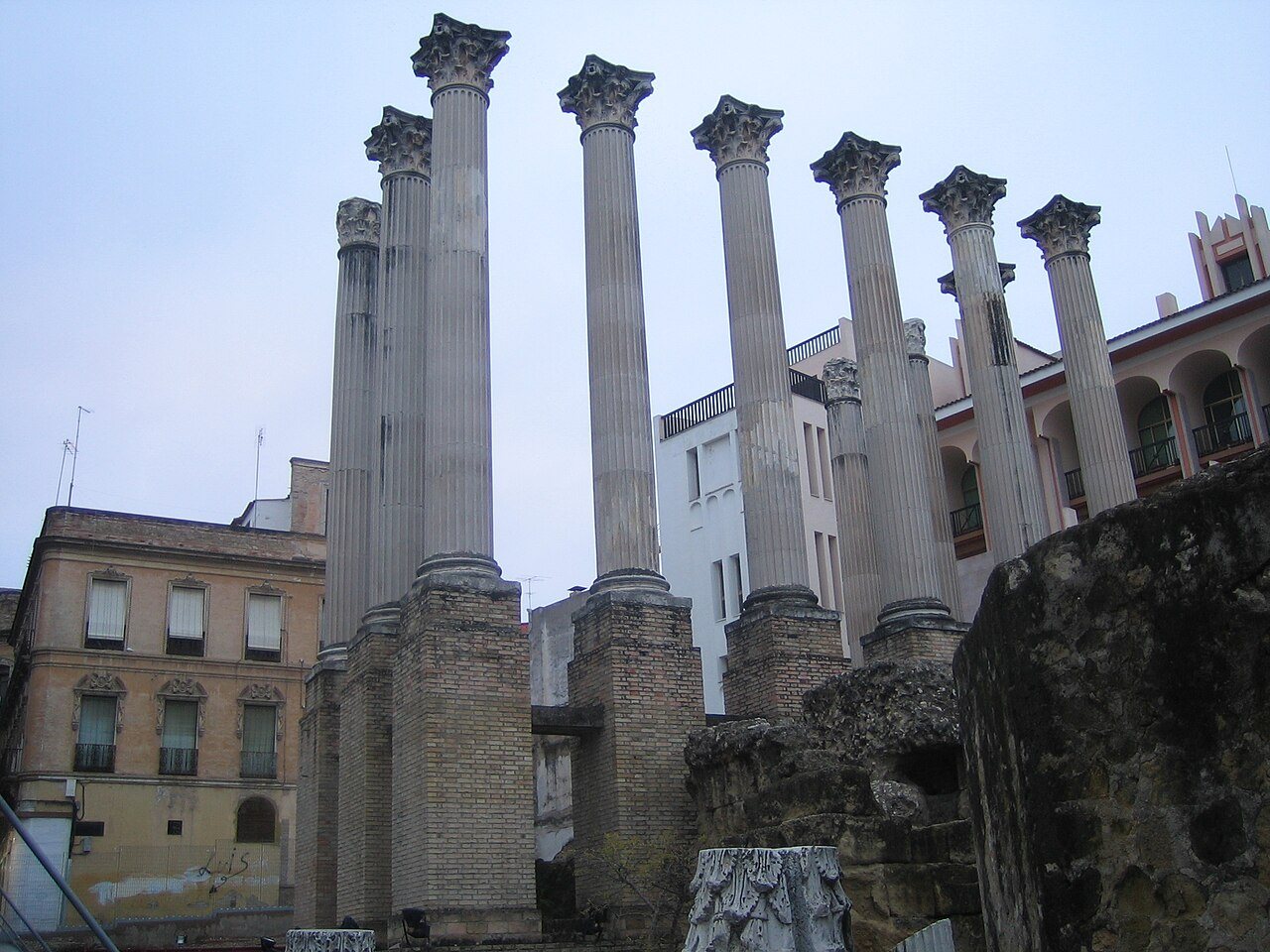
A short walk from the Ayuntamiento, on Calle Claudio Marcelo, a cluster of tall fluted columns rises behind railings at street level — the Templo Romano. These columns were re-erected in the twentieth century after archaeologists pieced together the podium and foundations of what had been a large temple, likely connected to the imperial cult, sited close to the city's forum. Its proximity to Córdoba's current seat of municipal government is not coincidence so much as continuity: this stretch of the old town has functioned as an administrative core, in one form or another, for roughly two thousand years. The temple's remains are fenced and viewed from outside rather than entered, but the columns alone give a sense of a monument built to be seen from well across the forum it anchored.
⚠️ The site is compact and often gets a quick glance-and-move-on from visitors heading toward Plaza de las Tendillas; slow down here, because this is one of the few spots in the city where Roman masonry is visible at full height rather than reduced to a floor plan.
The bridge's Roman bones
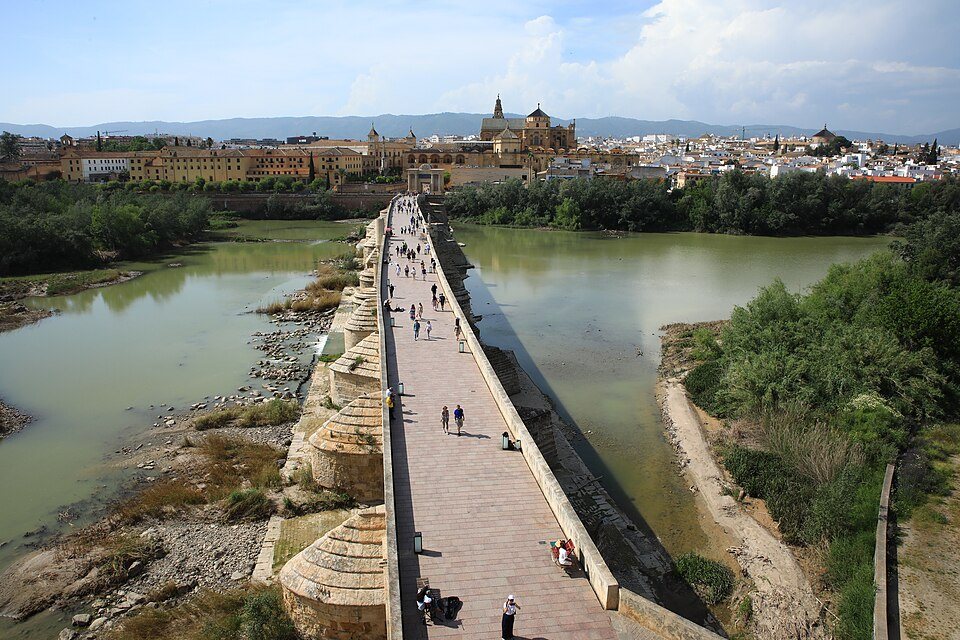
The Puente Romano crossing the Guadalquivir is Roman in origin and Roman in name, but not, strictly, Roman in most of its current stone. The original bridge dates to around the Augustan period and served as the fixed crossing point on the road south toward Seville and beyond; it has been repaired, rebuilt, and reinforced so many times through the Moorish, medieval, and modern periods that very little of the visible structure is first-century fabric. What survives is the alignment, the basic engineering logic of the piers, and — underneath the current roadway — some original Roman stonework incorporated into later rebuilding. It is less a preserved monument than a palimpsest: Roman plan, Moorish and medieval repair, modern restoration, all stacked on the same crossing because the river never moved and the logic of the ford never changed.
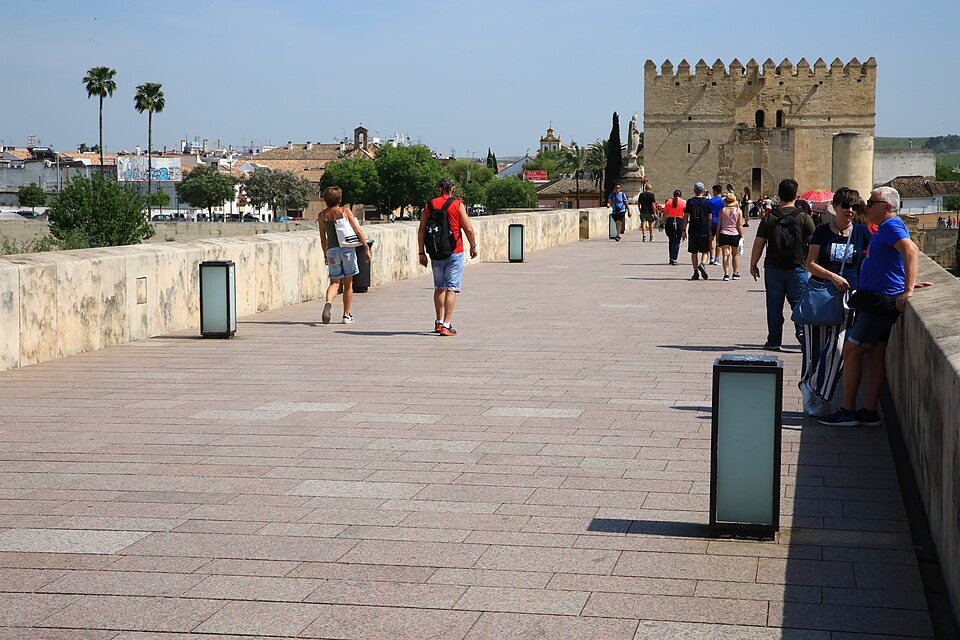
At the bridge's southern end stands the Torre de la Calahorra, an Almohad-era fortification built centuries after the Romans to guard the same crossing — proof that whoever controlled Córdoba kept coming back to defend this exact point on the river. At the northern end, the Puerta del Puente marks where the Roman and medieval city gate once stood, rebuilt in Renaissance form in the sixteenth century. Walk the bridge and you are tracing a line that Roman engineers chose and that nobody since has found a good reason to abandon.
Seeing the layers in one walk
These three sites — museum, city hall, bridge — sit close enough together to link into a short walk rather than three separate outings. Start at the Templo Romano near the Ayuntamiento, head toward the river past the Mezquita-Catedral (itself built on the site of a former Visigothic church, which in turn likely reused earlier Roman material, another layer in the same stack), cross the Puente Romano to the Torre de la Calahorra for the view back toward the old town, then circle to the Museo Arqueológico for the underground theater. None of this requires advance planning beyond checking the museum's current access arrangements for the theater section, since it runs on a separate schedule from the main galleries.
What's worth carrying away is not a list of ruins but the pattern: Córdoba's Roman city was not demolished to make way for what came after. It was built over, built into, and occasionally built around, which is why fragments of it keep surfacing in buildings that look, from the street, like they belong to entirely different eras. For more on how those later layers fit together, see Al-Andalus and the wider rundown of sights across the old town.
In pictures