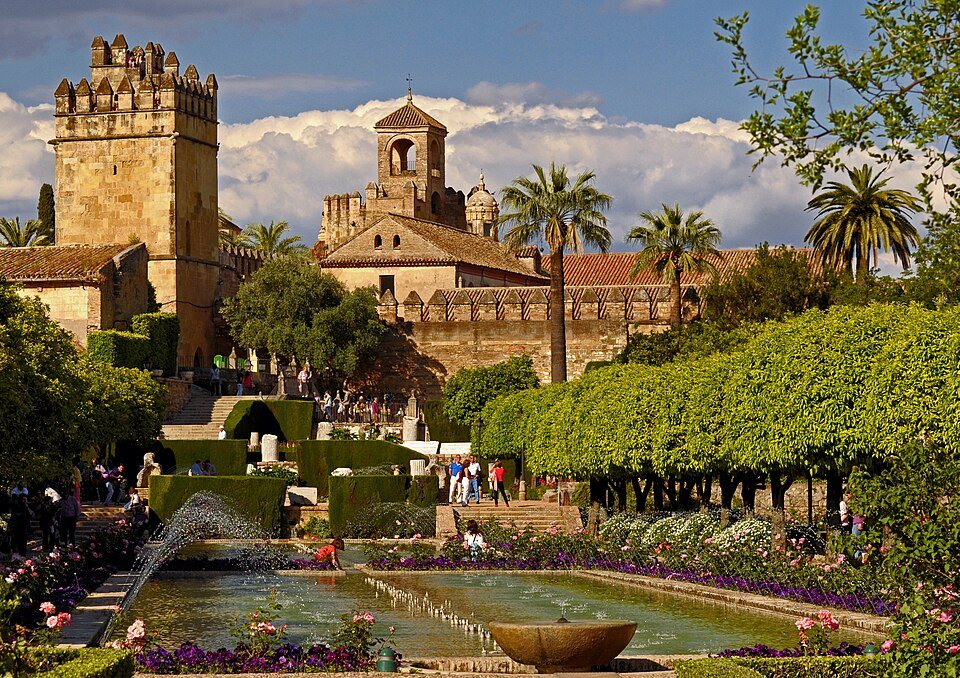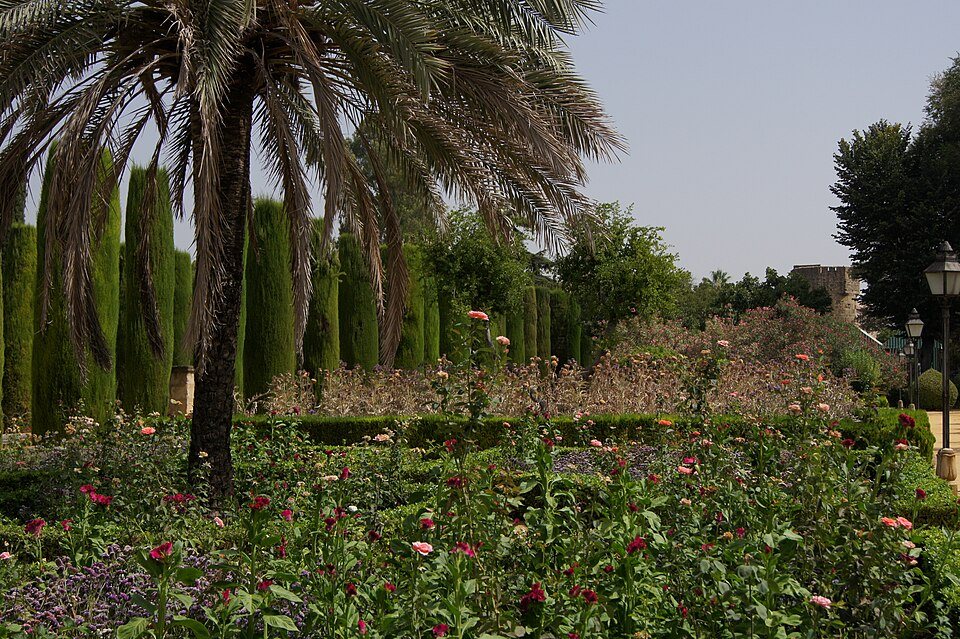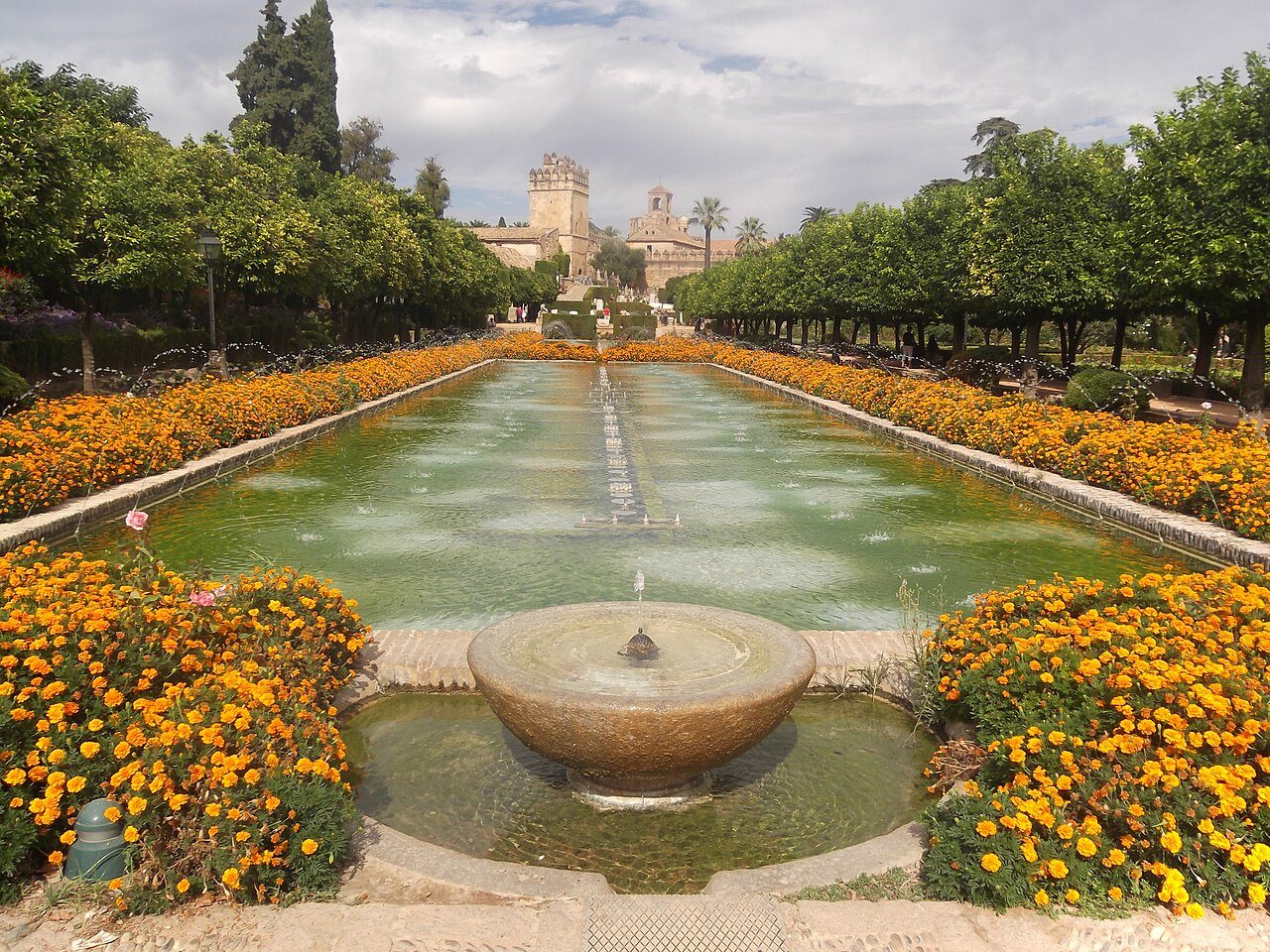
The gardens below the Alcázar de los Reyes Cristianos are smaller than photographs make them look. What they lack in scale they make up for in geometry: long rectangular pools stepped down a slope, clipped hedges in tight formal rows, and towers at the corners that give you something to line up in a shot. Most visitors see them for twenty minutes on the way out of the fortress. That's a mistake, and also not entirely their fault — the gardens are easy to treat as a postscript to the building itself.
They aren't medieval in the way the walls above them are. What you're walking through is largely a 20th-century reconstruction and replanting, done after the site spent a long stretch as a military prison. The layout borrows the idea of the Islamic-era courtyard garden — water as the organizing axis, trees as walls, everything symmetrical — without claiming to reproduce one plant for plant. Worth knowing before you go looking for something explicitly "Caliphal" down there; the real Caliphal-era water engineering, what's left of it, is a different kind of site entirely, more visible in places like Medina Azahara or the Baños Califales near the mosque.
Why the hour matters more than the day
The gardens face roughly east-west along their main pools, and the surrounding hedge walls throw hard shade for a good part of the afternoon in summer. Arrive in the middle of the day in July and you'll get flat light, a lot of squinting, and water that looks gray rather than reflective. The pools work as mirrors only when the sun is low enough to hit the surface at an angle instead of straight down — which in practice means the first couple of hours after opening, or the last stretch before closing, depending on the season and which direction you're facing. ⭐ If photographing the reflection of the towers in the long pools is the point of your visit, go in the morning. The main tower sits at the north end, and morning light coming from the east catches its face without the silhouette problem you get in late afternoon.
There's a second, more practical reason to pick a specific hour: tour groups. Cruise and coach groups tend to move through the Alcázar on a predictable cycle, and the gardens are usually the last stop before the exit, which means they arrive in waves rather than a steady trickle. A quiet pool can fill with thirty people for ten minutes and then empty again. If you want the place close to empty, go right when it opens, before the first coaches have worked their way through the building above.
Evening visits exist here too, in warmer months, when the gardens are lit after dark and sometimes used for events — check with the site operator for current dates and access, since this isn't offered year-round and the arrangement changes by season.
What's actually worth stopping for
Skip the urge to photograph every hedge corner and instead slow down at three points:
- The long pools themselves. There are several, stepped at different levels, and the water is kept moving by small jets rather than left still — which means true mirror reflections are more about timing than luck. Stand at the southern end looking north for the classic framing with the tower behind.
- The statue group near the center. A sculptural grouping depicting Columbus presenting his voyage proposal to the Catholic Monarchs stands among the hedges — a reminder that this fortress, not just the Mezquita-Catedral or the old Jewish quarter, is tied into the story of 1492 and the years around it. It's easy to walk past without noticing what it depicts.
- The raised walkway along the perimeter. Most people stay on the ground-level paths between the pools. Climbing to the walkway that runs along the garden's edge gives you the only elevated view of the whole layout at once, and it's usually far less crowded than the paths below.
⚠️ The gravel paths are uneven in places and there's minimal shade once you're between the hedge rows. In peak summer heat, this isn't a spot to linger past mid-morning unless you're comfortable in direct sun for an extended stretch.
Getting the sequence right
The gardens sit at a lower level than the fortress proper, reached by a staircase near the exit from the main rooms. Because of that layout, you can't easily double back and forth between the towers and the gardens — most visitors do the interior first, then descend once, which is part of why the gardens get treated as an afterthought rather than a destination in their own right. If the gardens are genuinely your priority — for the light, for photography, for a quiet walk rather than a history lesson — consider budgeting your visit the other way around: move through the interior rooms relatively quickly and save your slower, unhurried time for the terraces below. The ticketing and entry system is organized by the site operator and is worth checking directly before you go, since access points and any timed arrangements can change.
The Alcázar sits close enough to the river that it's easy to combine with a walk along the Puente Romano or a stop at the Torre de la Calahorra on the far bank — both make sense either before or after, depending on which direction the light is working for you that day. For a broader sense of how this fits into a day in the old city, the itineraries section has suggested routes that place the gardens alongside the Judería and the Calleja de las Flores without doubling back across town.
A note on expectations
These are not the courtyard patios you'll see in the May festival, and they're not an archaeological site in the way the Medina Azahara ruins are. They're a designed, maintained, relatively modern garden built on top of and alongside a genuinely old fortress — and the gap between those two things is part of what makes the site interesting, rather than something to paper over. Go for the pools, the light, and the view from the perimeter wall rather than expecting a fragment of the medieval city preserved intact. Judged on those terms, an early slot on a clear morning is close to the best version of the experience the site has to offer.
In pictures