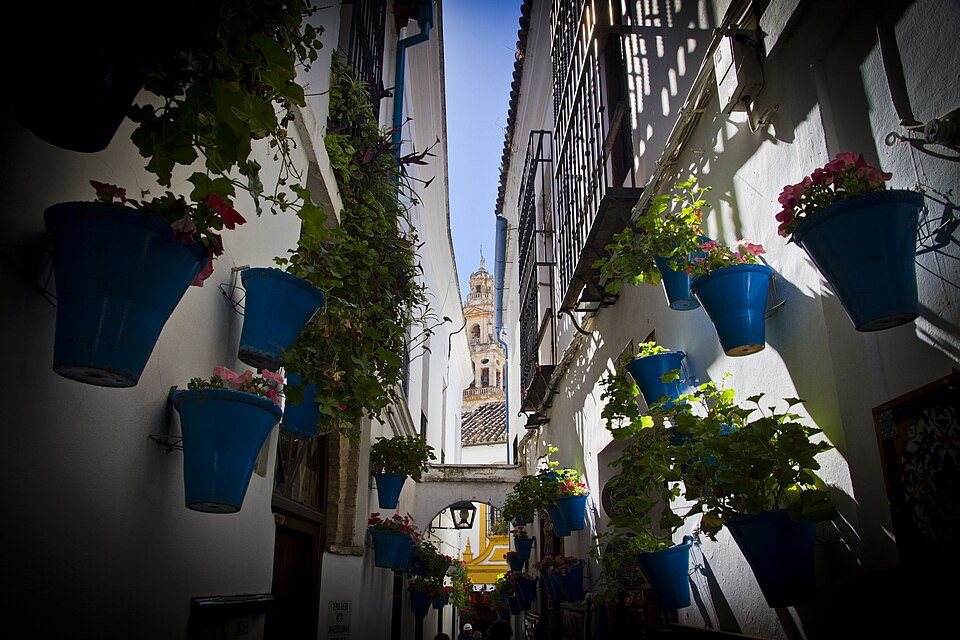
Every visitor to Córdoba ends up, at some point, wedged between two walls on Calleja de las Flores, phone held up for the shot of flowerpots framing the Mezquita-Catedral's bell tower. It's a genuine sight, and the neighboring Calleja del Pañuelo, so narrow it supposedly forces two people to turn sideways to pass, gets the same treatment. Both are worth seeing once. Neither is the Judería. The old Jewish quarter is a whole tangle of streets north and west of the Mezquita, and most of it goes unseen by people who arrive, snap the flowerpots, and head back toward the river.
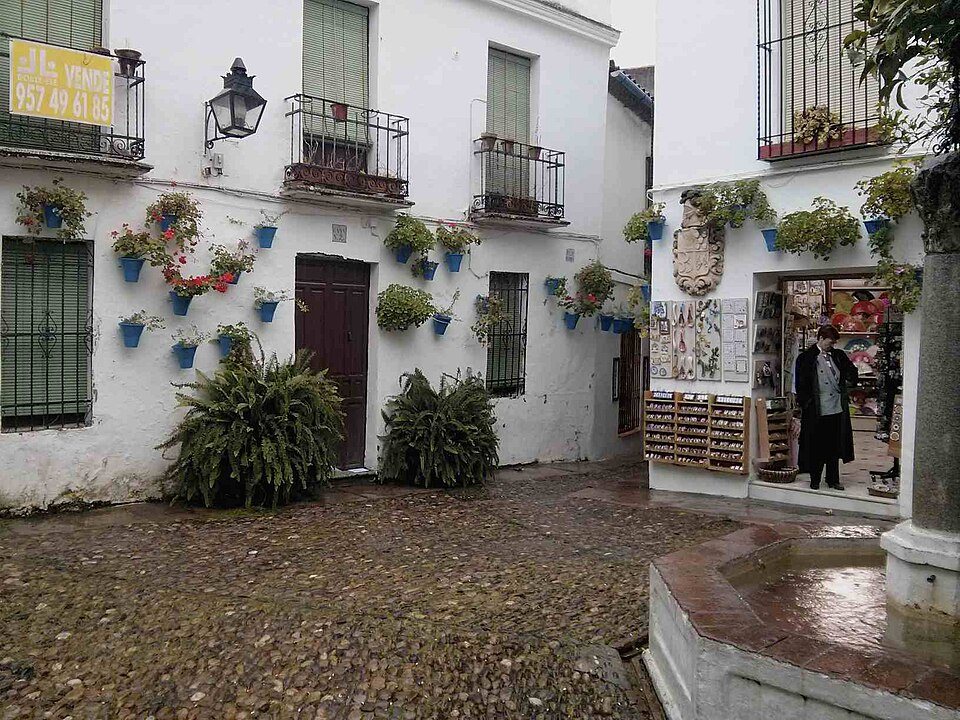
That's a shame, because the quarter's real character shows up in the parts without a queue: a street that dead-ends at a courtyard gate, a stretch of old wall with a worn Hebrew inscription nobody stops for, a square where the only sound is someone's television through an open window. Córdoba's historic center was built for foot traffic on a human scale centuries before anyone thought to call it charming, and the Judería is where that's easiest to feel once you step off the two famous lanes.
What "Judería" actually means here
The name refers to the medieval Jewish quarter that stood here under both Islamic and later Christian rule, roughly from the tenth century until the expulsion of Spain's Jewish population in 1492. It was never a ghetto in the later European sense; it was a walled district with its own gates, inhabited mostly but not exclusively by Jewish families, pressed up against the western flank of the Mezquita. Today the term is used more loosely, covering the whole warren of lanes between the mosque-cathedral and the old city wall near Torre Malmuerta, regardless of who actually lived where eight hundred years ago.
That looseness matters for visitors because it means "the Judería" isn't one monument you check off, it's a district you walk through, and its edges blur into areas covered elsewhere on this site, including the approach to the Alcázar de los Reyes Cristianos and the general sweep of Al-Andalus-era Córdoba. Treat it as a zone for wandering rather than a single stop, and budget real time for it rather than the twenty minutes most itineraries allow between the Mezquita and lunch.
The synagogue, and why it's rare
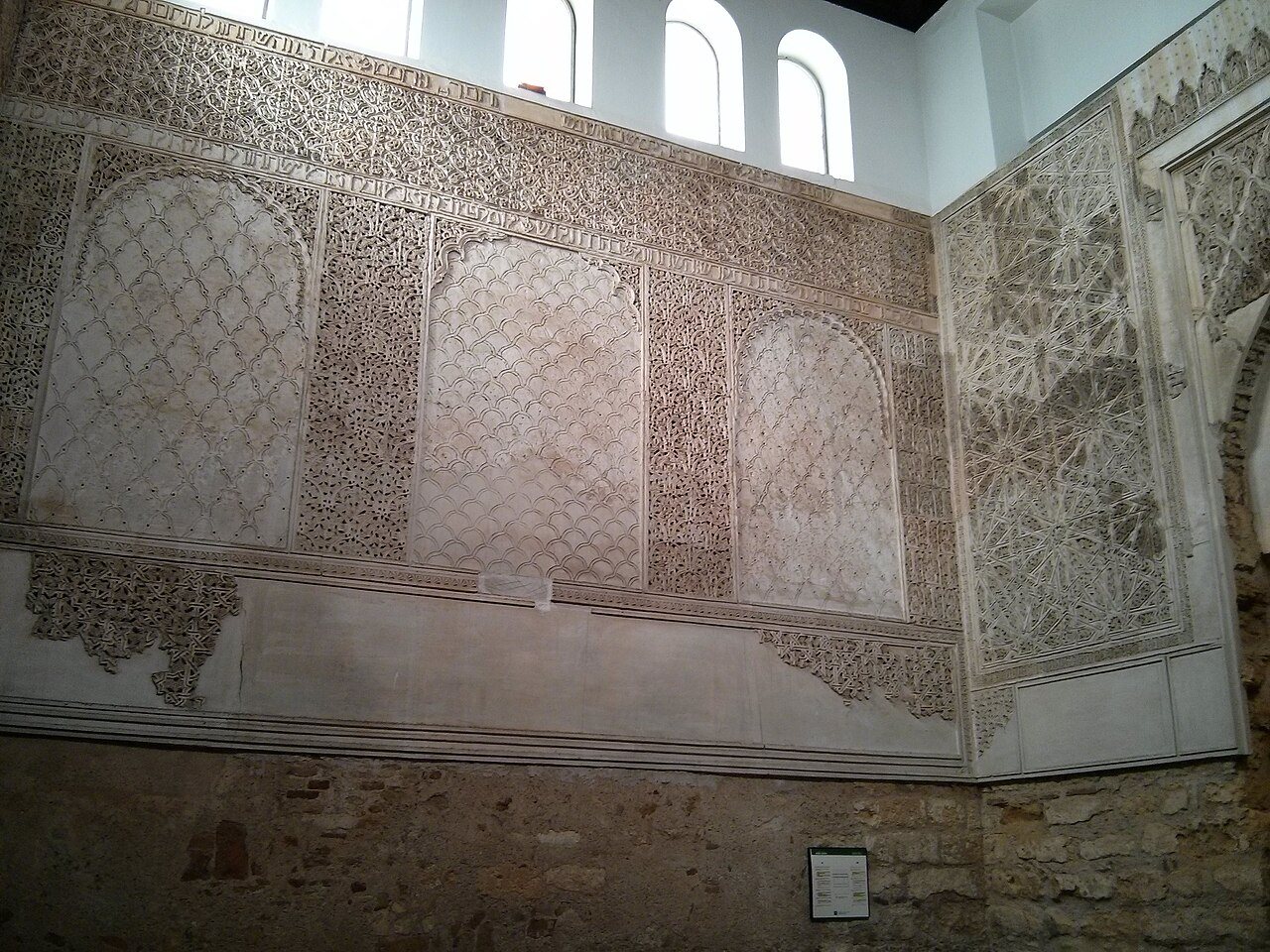
The one unmissable building off the two famous lanes is the Synagogue of Córdoba, tucked down Calle Judíos. It's small, a single room with a women's gallery above, decorated with Mudejar plasterwork and Hebrew inscriptions from the Psalms. What makes it worth the detour is scarcity: it's one of only a handful of medieval synagogues still standing anywhere in Spain, and the only one in Andalusia open to the public in anything like its original form. After the 1492 expulsion the building was converted for other uses, including as a hospital and later a shoemakers' chapel, which is part of why its interior survived rather than being demolished outright. Entry is managed through a ticket desk with its own queueing system, separate from the Mezquita's; check current arrangements with the site operator before you plan the rest of the morning around it, since the room is tiny and groups are moved through in batches. ⭐ Arrive without a tour group attached and you'll sometimes get the room to yourself for a minute, which is the difference between glancing at the plasterwork and actually reading it.
Nearby, the Casa de Sefarad occupies a cluster of connected houses facing the synagogue and covers Sephardic Jewish life, music, and craft in more depth than the synagogue building itself can, given its size. It isn't on this site's list of standing pages, so treat any mention of it elsewhere as a pointer rather than an endorsement of specific details.
Streets worth the detour
Away from Calle Judíos, a few specific routes reward a slower pace:
- Calle Averroes and Calle Deanes, which run roughly parallel to the Mezquita's western wall, carry much of the gift-shop trade but also some of the quarter's oldest stonework at eye level, including reused Roman and Visigothic fragments built into later walls.
- Plaza Maimónides, a small square named for the philosopher born nearby in 1138, holds a modest statue and a cluster of cafés with outdoor tables — a reasonable place to sit rather than a sight in itself.
- Calle Encarnación and the streets toward Campo Santo de los Mártires, closer to the Alcázar, thin out noticeably once you're past midday, and the courtyard gates along here are some of the Judería's least photographed.
- The old gate line near the western wall, where sections of the medieval Jewish quarter's boundary are still traceable in the street pattern even where the stone itself is gone.
None of these demand an entrance fee or a ticket; they're public streets, and the appeal is simply walking them without an agenda. ⚠️ The trade-off is that there's very little signage explaining what you're looking at, so a guidebook or a guided walk pays off more here than at the headline sights, where information panels do some of the work for you.
Patios, doorways, and the limits of looking
The Judería overlaps with Córdoba's patio culture, covered in more detail under Patios, but it's worth flagging here: many of the flower-filled courtyards visible through wrought-iron gates along these streets are private homes, not attractions, and are only opened to the public during the city's patio festival each spring. The rest of the year, a half-open gate offering a glimpse of tiled walls and potted geraniums is someone's front hall, not an exhibit. Admiring from the threshold is normal and welcomed; stepping inside uninvited is not, and locals notice the difference immediately.
The same courtesy applies to the quieter residential lanes generally. The Judería is a living neighborhood as well as a historic district, with people doing ordinary Tuesday things behind those whitewashed walls, which is part of why it feels different from the souvenir-stall density around the two famous lanes.
Getting your bearings
The Judería is compact enough to cover on foot from almost anywhere in the old city; see Getting Around for how it connects to the rest of central Córdoba. A sensible approach is to let the Mezquita-Catedral anchor one end of a loop and the Alcázar the other, with the synagogue and Plaza Maimónides somewhere in the middle, and simply allow wrong turns. Getting briefly lost here costs nothing and tends to produce the photo, or the quiet courtyard, that the two famous lanes can't give you because everyone else is standing in exactly the same spot. For a structured version of this walk alongside the city's other districts, the Itineraries section lays out a few options, and Food & Drink covers where to stop once you've earned a seat.
In pictures