Córdoba in summer gets hot enough that the local news runs it as a daily statistic, and the old city was not built by people who assumed the problem would go away. Long before air conditioning, the streets, walls, and courtyards of the historic center were arranged to manage sun and airflow as deliberately as a modern building manages its ductwork. Understanding that system changes how you walk the city — where to go at 1pm, where the actual shade is, and why the street suddenly jogs sideways for no apparent reason.
Why the streets bend and narrow
The grid under the old quarter is partly Roman, but the overlay you actually walk through — crooked, pinched, full of dead ends and blind turns — is largely the product of centuries of Islamic-era urban growth, when streets were widened or narrowed organically rather than planned on paper. A street that narrows to the width of two people walking shoulder to shoulder is not an accident of medieval crowding; a narrow street with tall walls on both sides shades itself for most of the day, since the sun has to climb high enough to clear the rooflines before it reaches the pavement. Wide, straight boulevards do the opposite — they let the sun hit the ground almost all day. That's part of why the Judería and the lanes around it feel noticeably cooler at noon than the open plazas just a few minutes' walk away.
The bends matter too. A street that curves breaks up the wind tunnel effect but also breaks the sun's straight shot down the corridor. Walk Calleja de las Flores at midday and you'll notice it's shaded almost end to end, not because someone strung up awnings but because the lane is so narrow and bent that direct light rarely reaches the ground. The flowerpots crowding the walls are a local signature, but they're sitting on a street that was already doing the hard work.
Whitewash, thick walls, and the courtyard as a cooling machine
The lime whitewash (cal) on almost every wall in the old city isn't cosmetic tradition alone — it reflects solar radiation instead of absorbing it, which keeps the walls themselves from turning into radiators by late afternoon. Underneath the whitewash, walls in older houses tend to be thick, which slows heat transfer so the interior lags hours behind the exterior temperature. A house can be at its coolest right when the street outside is at its worst, around mid-afternoon.
The patio is the more elegant piece of the system. A central courtyard, usually with a well or fountain and heavy planting, pulls cooler, denser air down and in while warmer air rises and escapes — a basic stack effect, helped along by evaporation from the water and the plants. Many houses have a zaguán, a shaded entrance hall with a wrought-iron gate (a reja) instead of a solid door, so air can move through even when the gate is the only thing open to the street. If you've ever walked past a Córdoba house and felt a noticeably cooler breath of air coming through the ironwork, that's the mechanism doing its job, not a lucky draft.
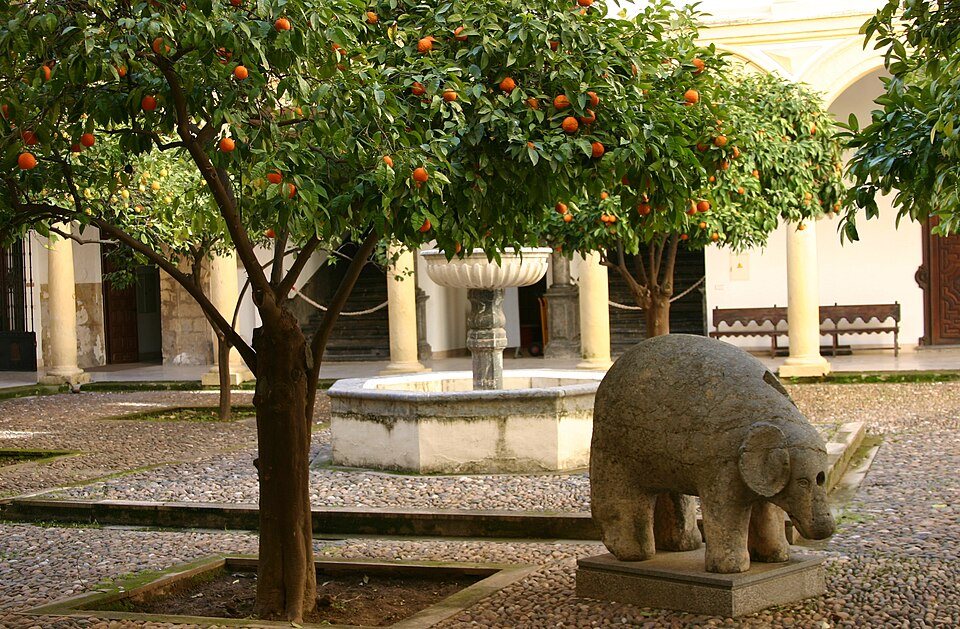
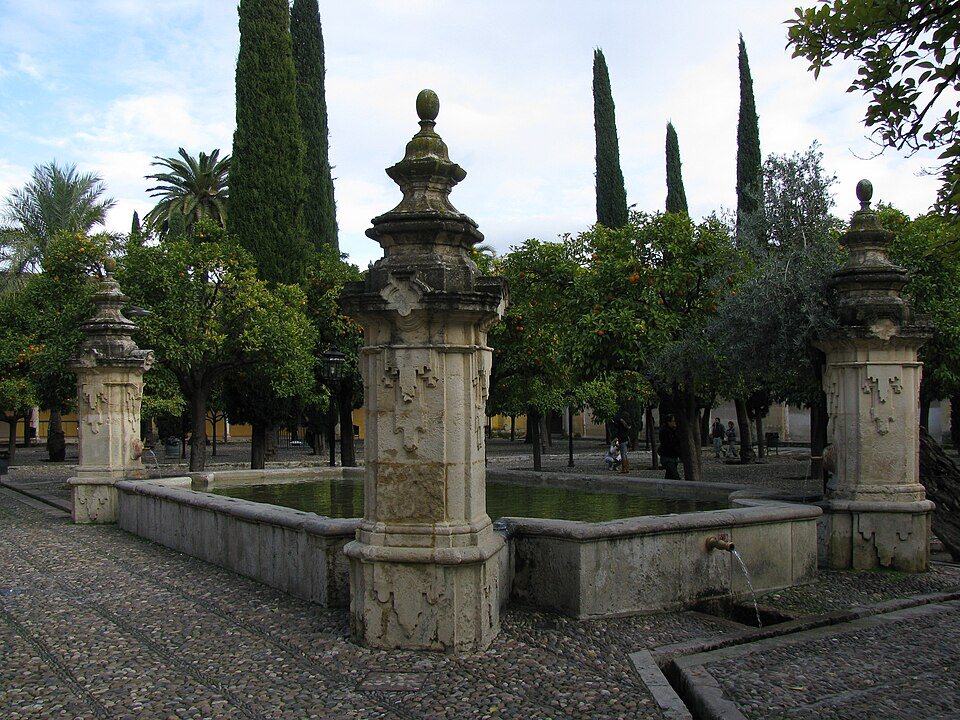
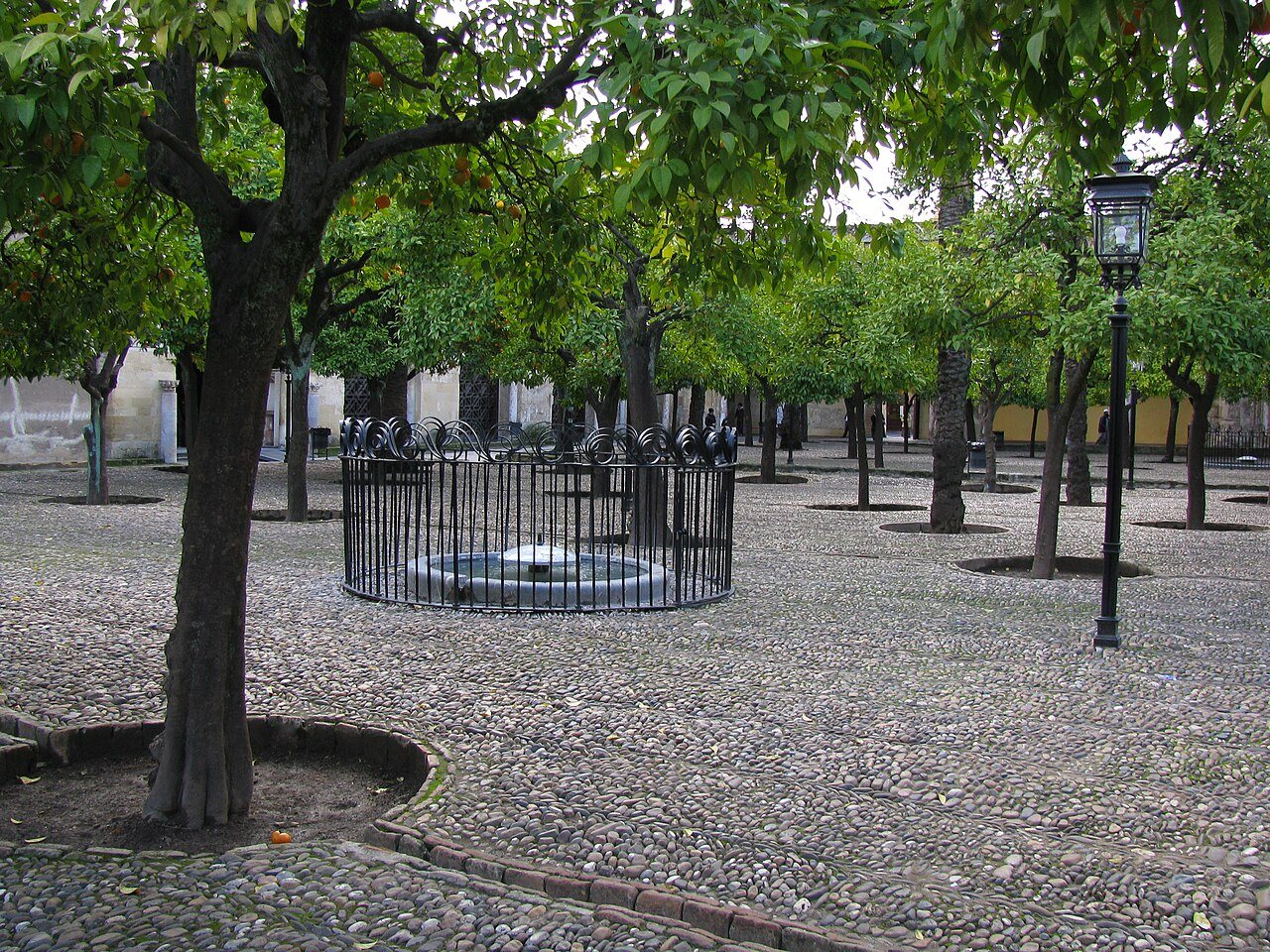
This is also why the Patios de San Basilio neighborhood exists as a sight in its own right, not just a festival curiosity: these courtyards are a genuine piece of climate design, maintained as living spaces, and worth visiting for that reason as much as for the flowers. The same logic shows up at grander scale in the Mezquita-Catedral, where the Patio de los Naranjos functions as a shaded, irrigated threshold before you even reach the building's own famously cool, dim interior — thick stone, deliberately low light levels, and a forest of columns that breaks up airflow and sightlines alike. ⭐ Sit on one of the benches under the orange trees for a few minutes before going in; it's the coolest free seat in the old city and it's also where the temperature difference is most obvious.
Walking it in practice
None of this is only historical interest — it's a usable map for getting around without wrecking your afternoon. The practical version is simple: the old quarter rewards zigzagging through its narrowest lanes rather than following the widest, most obvious route between two points. A street that looks like a shortcut on a phone map because it's straight and broad is often the one place you'll be in full sun the whole way.
- The area around the Judería and the streets feeding toward the Mezquita-Catedral stay shaded longest into the day because the lanes are narrowest and most convoluted there.
- Open spaces — the approach to the Puerta del Puente, the bridge itself, the embankment along the river — have almost no shade at all and are the worst places to be caught at midday, however good the view.
- ⚠️ The Puente Romano is stone over water with no cover whatsoever; crossing it in the early morning or evening is a different experience from crossing it at 2pm in July.
- Courtyards you can see into from the street through an open reja are, in effect, a free cooling break — it's considered fine to pause and look, though actually entering a private home is not.
Locals adjust their whole schedule around this rather than fighting it: shops and sights cluster their hours around the cooler parts of the day, with a long gap in the middle, and the streets genuinely empty out at the hottest hour and refill once the sun drops. Trying to sightsee through that dead stretch is the single most common way visitors end up exhausted and irritable by early evening. It's worth building your own day the same way — see the sights that have real cover (patios, the Mezquita's interior, museum galleries) in the middle of the day, and save open-air spots like the Torre de la Calahorra riverside approach or the Plaza de la Corredera for morning or evening light.
For a sense of how to sequence a day around this, the itineraries section groups sights by how exposed they are, and food and drink covers where to sit out a long lunch exactly when the street outside is at its worst. The short version, though, is the one Córdoba's builders worked out long before anyone wrote a guidebook: when in doubt, go narrow, go white, and go toward water or greenery. The city was built to make that the comfortable choice.
In pictures